Homemade Soft Pretzels
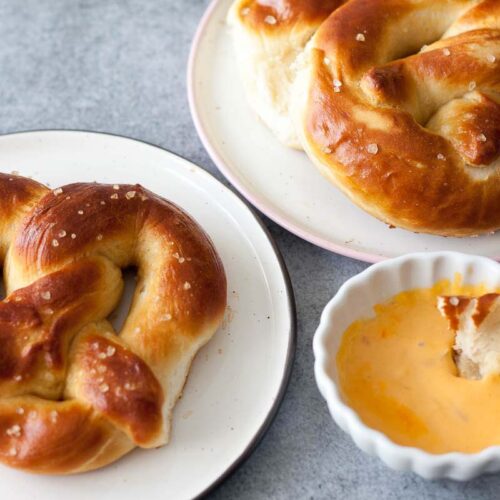
This easy homemade soft pretzels recipe uses a combination of all-purpose and bread flour to give that soft and chewy bread texture. These pretzels are best eaten immediately after baking. Dip them in your favorite cheese sauce or simply slather with melted butter.On measuring: All recipes are developed and tested in metric grams. I have provided a conversion to US customary (based on this Baking Conversion and Measurement Chart) in the recipe but I strongly recommend using a digital scale for a more accurate result. Step-by-step photos: If there's any step you feel confused, my recipe post contains step-by-step photos and helpful tips to guide you in making this recipe. Go to >>> https://bakeologie.com/easy-homemade-pretzels/
Print Recipe
Ingredients
- 122g (½ cup) full-fat or whole milk
- 5g (1 ¼ ) tsp instant yeast
- 18g (1½ tablespoons) brown sugar
- 14g (1 tablespoon) melted butter
- ½ teaspoon fine salt
- 94g (¾ cup) all-purpose flour plus more for dusting
- 94g (¾ cup) bread flour
- neutral-tasting oil ex. canola, vegetable oil
- 54g (3 tablespoons) baking soda
- 300g (1 ¼ cup) hot boiling water
- 1 piece egg any size
- 1½ teaspoon pretzel salt or coarse sea salt
- 42 g (3 tablespoons) melted butter for brushing the tops of pretzel after baking
Instructions
- PREP. Measure all the ingredients. Warm the milk in the microwave or saucepan until it’s about 43 C (110 F).
- MAKE THE DOUGH. In a large mixing bowl, combine warm milk, brown sugar and yeast. Mix together and set aside for 4 minutes or until it begins to bubble.Add the melted butter, salt, all-purpose flour, and bread flour. Stir with a wooden spoon until a dough forms. If the dough is too sticky, add more all-purpose flour in small increments (about 1 tbsp each) until it is not sticky. Transfer the dough to a floured surface and knead for about 3 minutes. Shape it to a ball.PRO TIP: Do the windowpane test. A great way to know if your dough is kneaded enough is to do the windowpane test. Here’s how you do it. Remove a small piece of dough about the size of a golf ball and gently stretch it to create a thin membrane-like pane or windowpane, it should be thin enough to see light through it. If the dough breaks it means the gluten hasn’t developed properly and you need to knead it for a little longer.122g (½ cup) full-fat or whole milk, 5g (1 ¼ ) tsp instant yeast, 18g (1½ tablespoons) brown sugar, 14g (1 tablespoon) melted butter, ½ teaspoon fine salt, 94g (¾ cup) all-purpose flour, 94g (¾ cup) bread flour
- LET THE DOUGH RISE. Transfer the dough to a bowl drizzled with oil (to prevent the dough from sticking). Cover with plastic wrap and let it rise in a warm place, about 1 hour or until dough doubles in size.neutral-tasting oil
- When the dough has risen, you can start preheating your oven to 450 F/ 232 C. Punch the dough back down and divide into 6 sections (about 55 grams of dough each).
- Roll each section into a long skinny rope, about 20 inches long and ½ inch thick. The dough rope should be even in thickness throughout.
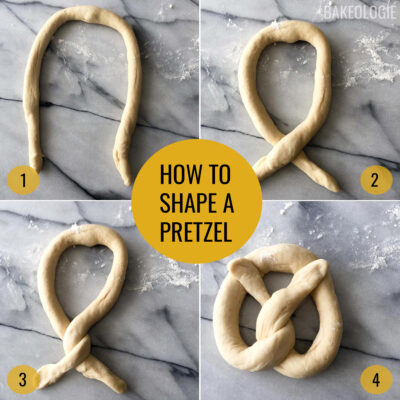
- Shape it into a pretzel.Take the dough rope and lay it horizontally on your work surface. Grab both ends and bring them upward to form a wide, INVERTED “U” shape. Cross the two ends of the dough rope over each other, about two to three inches from the top of the “U”. Twist them once to form a simple knot. After twisting the ends, fold them up towards the top of the “U”, and press them gently onto the dough where it touches. This will create the traditional pretzel shape. Make sure to pinch the ends lightly so they stay in place during baking.
- PRETZEL-IFY WITH BAKING SODA BATH. Make the baking soda solution by combining hot (just boiled) water with baking soda in a shallow bowl. Ensure that baking soda has dissolved by mixing it with a whisk. Drop each whole pretzel into the baking soda solution for about 30 seconds, then place on a parchment-lined baking sheet.54g (3 tablespoons) baking soda, 300g (1 ¼ cup) hot boiling water
- Beat an egg in a small bowl. Brush each pretzel with beaten egg and sprinkle with coarse salt.1 piece egg, 1½ teaspoon pretzel salt or coarse sea salt
- BAKE at 450 degrees for 9-10 minutes or until deep golden brown. Remove from the oven and brush with lots of melted butter.42 g (3 tablespoons) melted butter
Notes
Variations. Turn this into pretzel bites! Skip the shaping into pretzels. After rolling the dough into 1/2 inch thick, cut it into 1 ½ inch size to get pretzel bites. Baking time will be reduced since they are smaller.
Windowpane test. A great way to know if your dough is kneaded enough is to do the windowpane test. Here’s how you do it. Remove a small piece of dough about the size of a golf ball and gently stretch it to create a thin membrane-like pane or windowpane, it should be thin enough to see light through it. If the dough breaks it means the gluten hasn’t developed properly and you need to knead it for a little longer.
Servings: 6 pieces
