Shortbread Cookies - Two Ways
Buttery, delectably tender, and not that sweet shortbread cookies ready in 30 mins. A versatile and year-round cookie, from casual coffee break to an elegant tea party!
Print Recipe
Ingredients
- 120 g (½ cup + ½ tbsp) unsalted butter, at room temperature omit salt if using salted butter
- 60 g (½ cup) powdered sugar also called icing sugar/ confectioner's sugar
- ½ tsp pure vanilla extract
- 170 g (1⅓ cups) all-purpose flour
- 15 g cornstarch also called cornflour
- ¼ tsp fine sea salt omit if using salted butter
Instructions
- Preheat (convention oven, no fan) oven to 320℉ / 160℃ . Line a baking sheet with parchment paper.Ensure that your butter is at room temperature.
- Beat butter, powdered sugar, and vanilla extract until smooth, about 2-3 minutes on medium-low speed. Make sure to scrape down the sides and bottom of the bowl. It’s ready when the creamed mixture is pale in color. You don’t want to beat too much air because that air will cause the surface of the shortbread to puff up and bubble.120 g (½ cup + ½ tbsp) unsalted butter, at room temperature, 60 g (½ cup) powdered sugar, ½ tsp pure vanilla extract
- Sift the flour, cornstarch and salt over the butter mixture and beat them together starting at low speed and gradually increasing to medium-low speed.At the beginning of mix, your dough would like it’s too dry and will never come together. Be patient and keep the mixer going on at low speed. As the flour starts to become coated with the moisture of the creamed butter and sugar, the dough will form clumps.170 g (1⅓ cups) all-purpose flour, 15 g cornstarch, ¼ tsp fine sea salt
- Use your hands to press together to form a smooth-dish ball. Don’t knead! Simply squeeze it gently together and pressing the crumbly bits at the bottom of the bowl will bring together the dough. Shape it into a rough disk.
- If doing a rolled and cut-out shortbread: On a lightly floured surface roll out your dough with a lightly floured rolling pin until 1/4-inch (6mm) thick. TIP: Flour your work surface and the rolling pin only (avoid putting flour on the dough itself as this adds even more flour which can dry out the dough.
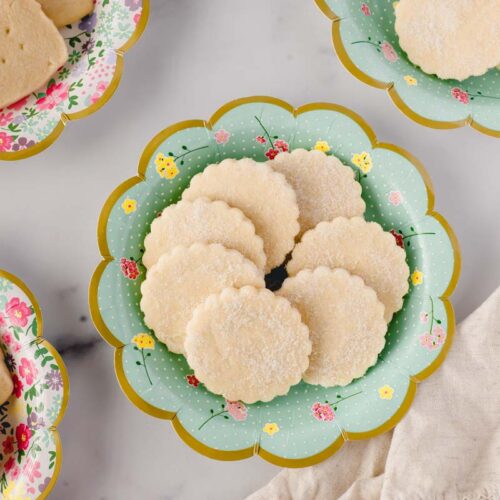
- Using your chosen cookie cutter and stamp out as many rounds as you can. Reroll the scraps and continue stamping until you have used up almost all the dough.I am using a 2.25-inch scalloped cookie cutter and I was able to yield 20 cookies.TIP: Dip you cookie cutter in flour to prevent the dough from sticking to the inside edge of the cutter.
- Place the cookies on a baking sheet about 1-inch apart. If you find that the cut-out dough is sticking to your surface, slide a floured spatula or off-set spatula under the cookie round and gently lift it.
- Bake for 10 mins or until the cookies are firm to touch and they have minimal coloring on them.Remove from the oven and leave to cool on the pans, then transfer to a wire rack.
- OPTIONAL: Coat with granulated sugar once the cookies are cooled. I like this step as it add a bit of texture and sweetness. My kids also said that the cookies look fluffy this way!
- If you're doing the slice and bake shortbread,press the dough together and shape into a rectangular log about 3 ½ cm x 6 cm (1.4″x2.3″), squaring off the edges with a bench scraper.
- With a sharp knife, cut the shortbread into biscuits 1cm (0.4″) thick. Using a skewer or a fork, press holes about halfway down into the dough, and arrange on the trays, leaving a little room for spreading. They don’t spread too much.Follow steps 8 and 9 for baking.
Notes
Step-by-step photos: My recipe post contains step-by-step photos and tips to guide you in making this recipe >>> https://bakeologie.com/easy-shortbread-cookies
On measuring: All recipes are developed and tested in metric grams. I have provided a conversion to US customary in the recipe but I strongly recommend using a digital scale for a more accurate result.
To store: The shortbread cookie dough can be made in advance. Wrap very well with plastic wrap and store the dough for up to a week in the fridge. Cookies can be stored in an airtight container on the countertop for up to 7 days.
Servings: 20 cookies
