Gingerbread Crinkle Cookies (Soft & Fudgy)
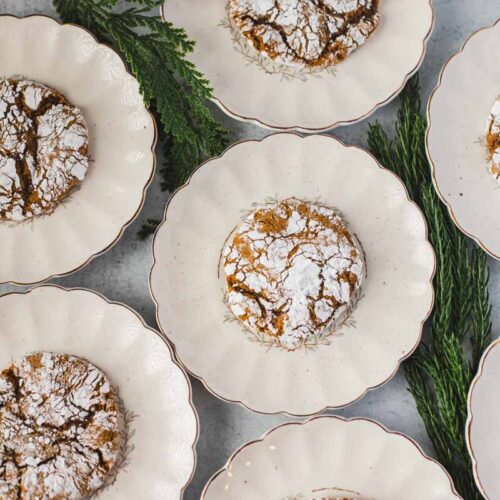
Soft, fudgy molasses crinkles with warm gingerbread spices, slightly crunchy edges, and snowy powdered sugar cracks.
Print Recipe
Ingredients
- 65g (⅓ cup ) granulated white sugar
- 85g (about ⅓ cup + 1 tablespoon, packed ) dark brown sugar
- 45g (3 tablespoons + 1 teaspoon ) neutral oil, such as canola oil
- 55g about 2 tablespoons + 2 teaspoons fancy molasses Do not use balckstrap molasses.
- 50g (about 1 large whole egg) eggs, at room temperature (weight is without shell)
- 20g (about 1 large egg yolk) egg yolk, at room temperature
- 1 teaspoon vanilla extract
- 190g (about 1½ cups) all-purpose flour. If measuring by cups, use the spoon-and-level method.
- 1¼ teaspoons ground ginger
- 1 teaspoon ground cinnamon
- 1/16 teaspoon ground cloves one measuring pinch
- ⅛ teaspoon ground nutmeg
- 2g (½ teaspoon) baking powder
- 1g (¼ teaspoon ) baking soda
- 1.5g (¼ teaspoon) fine sea salt
- 60g (½ cup) powdered sugar/ icing sugar, or as needed
Instructions
- Mix the wet ingredients. In a large bowl, whisk the granulated white sugar, dark brown sugar, neutral oil, fancy molasses, whole egg, egg yolk, and vanilla extract until smooth, thick, and glossy, with no large brown sugar lumps.65g (⅓ cup ) granulated white sugar, 85g (about ⅓ cup + 1 tablespoon, packed ) dark brown sugar, 45g (3 tablespoons + 1 teaspoon ) neutral oil, such as canola oil, 55g about 2 tablespoons + 2 teaspoons fancy molasses, 50g (about 1 large whole egg) eggs, at room temperature (weight is without shell), 20g (about 1 large egg yolk) egg yolk, at room temperature, 1 teaspoon vanilla extract
- Add the dry ingredients. Add the all-purpose flour, ground ginger, ground cinnamon, ground cloves, ground nutmeg, baking powder, baking soda, and fine sea salt directly to the bowl, sprinkling the spices and leaveners evenly over the flour. Fold gently with a spatula, scraping the bowl, until no dry flour remains. The dough will be thick and sticky; don’t add extra flour.190g (about 1½ cups) all-purpose flour. If measuring by cups, use the spoon-and-level method., 1¼ teaspoons ground ginger, 1 teaspoon ground cinnamon, 1/16 teaspoon ground cloves, ⅛ teaspoon ground nutmeg, 2g (½ teaspoon) baking powder, 1g (¼ teaspoon ) baking soda, 1.5g (¼ teaspoon) fine sea salt
- Cover and chill. Press plastic wrap directly against the dough’s surface to prevent a dry skin. Refrigerate for at least 1 hour, or until firm enough to scoop and roll (often 1½–2 hours).
- Preheat the oven. Heat to 350°F (175°C), conventional/no fan, with a rack in the middle. Line a half-sheet pan with parchment paper.
- Portion the dough. Using a kitchen scale, divide the chilled dough into 40g portions (about 2½ tablespoons of dough per cookie). If you don't have a kitchen scale, use a slightly heaping 2-tablespoon cookie scoop.Gently roll each portion between your palms to form a smooth ball. If the dough becomes too soft or sticky while you're working, return it to the refrigerator briefly.
- Coat with powdered sugar. Put the powdered sugar in a small bowl and generously roll each dough ball until fully white. Don't let the coated dough sit for too long, as it may absorb some of the sugar.60g (½ cup) powdered sugar/ icing sugar, or as needed
- Arrange on the pan. Space the dough balls roughly 3 inches apart; approximately 8 fit on a half-sheet pan.
- Bake. Bake one pan at a time for 10–11 minutes. Look for cracked, puffed tops, set edges, and slightly soft centers. Start checking at 10 minutes for the fudgy texture.
- Cool. Let the cookies cool on the baking sheet for approximately 10 minutes, then move to a wire rack. They will settle as they cool; that’s normal.
Weighing flour is most accurate. If using cups, see how to measure flour correctly and use the spoon-and-level method.
TIP: Don't skip the chilling time! Refrigerating the dough allows the flour to absorb moisture, making the dough firmer and less sticky. This makes it much easier to roll into balls and coat with powdered sugar without having to add extra flour, which could compromise the cookies' fudgy texture.
Use an oven thermometer to check that your oven has actually reached 350°F (175°C) before baking. Your oven's built-in temperature display may not always be accurate. An oven that's too hot or too cold can affect how much the cookies spread, how well they crack, and how fudgy the centers turn out.
If you're baking in batches, let the baking sheet cool completely before placing more dough balls on it. Alternatively, use two baking sheets and alternate between them, baking one sheet at a time. Placing cookie dough on a hot baking sheet can cause the cookies to spread too quickly.
Notes
Storage: Allow the cookies to cool completely before storing them in an airtight container at room temperature for up to 3–4 days. If stacking the cookies, place a sheet of parchment paper between the layers to help protect the powdered sugar coating. The slightly crunchy edges may soften over time, and the powdered sugar may absorb some moisture, but the centers should remain soft and fudgy.
Servings: 12 cookies (40g each)
