
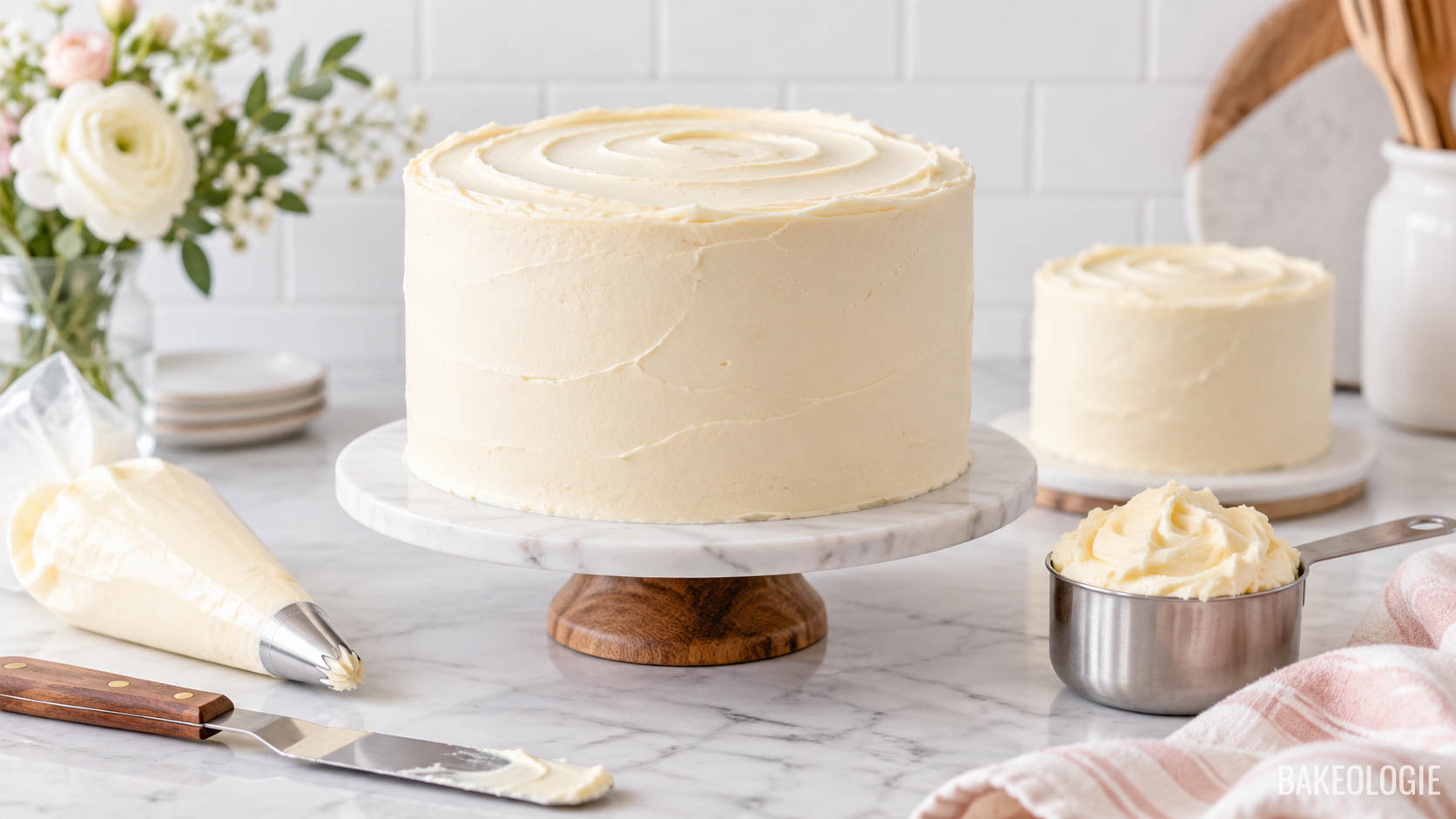
There are few things more annoying than getting halfway through frosting a cake and realizing you’re running out of buttercream.
Make too little, and you’re suddenly washing the mixer bowl and making another batch while your half-frosted cake waits. Make way too much, and you’re staring at a bowl of leftover buttercream wondering why you apparently prepared to frost a small wedding.
So, how much buttercream do you actually need?
For many common 6- to 9-inch round layer cakes, you’ll need roughly 2½ to 6½ cups of buttercream, depending on the diameter of the cake, how tall it is, how much buttercream you use between the layers, and how you plan to decorate it. Smaller cakes may need less, while larger cakes can require considerably more.
The chart below gives you a good starting point for filling, crumb coating, and finishing a cake with a standard smooth coat.
Quick Buttercream Chart for Round Cakes
For this chart, I’m assuming each cake layer is approximately 1½ to 2 inches tall before filling. A 2-layer cake will usually finish around 4 inches tall, while a 3-layer cake will usually finish around 5½ to 6 inches tall.
These amounts are planning estimates rather than exact measurements. Buttercream needs vary because bakers use different amounts between the layers and different thicknesses for the exterior coat.
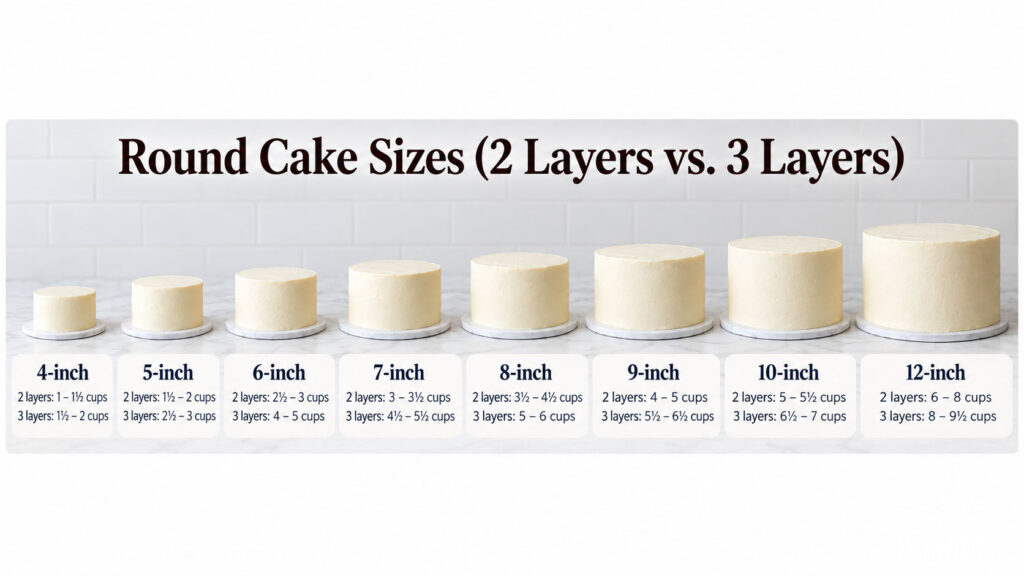
| Round Cake Size | 2 Layers — about 4 inches tall | 3 Layers — about 5½–6 inches tall |
|---|---|---|
| 4-inch | 1–1½ cups | 1½–2 cups |
| 5-inch | 1½–2 cups | 2½–3 cups |
| 6-inch | 2½–3 cups | 4–5 cups |
| 7-inch | 3–3½ cups | 4½–5½ cups |
| 8-inch | 3½–4½ cups | 5–6 cups |
| 9-inch | 4–5 cups | 5½–6½ cups |
| 10-inch | 5–5½ cups | 6½–7 cups |
| 12-inch | 6–8 cups | 8–9½ cups |
These estimates include buttercream between the cake layers, a thin crumb coat, and a standard smooth final coat. They do not include significant decorative piping such as large swirls, rosettes, buttercream flowers, or Lambeth-style decorations.
When in doubt, I recommend using the higher end of the range. Having half a cup of buttercream left over is much less stressful than running out when you have 3 inches of cake left to frost.
Thin Cake Layers Mini-Chart
If your cake layers are only ½ inch or 1 inch tall, use this mini-chart instead of the main chart above. The main chart assumes cake layers approximately 1½ to 2 inches tall each.
You’ll usually need less buttercream if the finished cake itself is shorter. But if you split thicker cake layers into several thin layers and keep about the same finished height, you may still need a similar amount for the outside — and possibly more for filling because there are more spaces between layers.
These are planning estimates for a standard smooth finish with a moderate layer of buttercream between the cakes. Use the higher end if you like thicker filling or a more generous exterior coat.
2-Layer Cakes with Thin Layers
| Round Cake Size | 2 layers of ½-inch each | 2 layers of 1-inch each |
|---|---|---|
| 6-inch | 1½–2 cups | 2–2½ cups |
| 8-inch | 2½–3½ cups | 3–3½ cups |
| 9-inch | 3½–4 cups | 4–4½ cups |
3-Layer Cakes with Thin Layers
| Round Cake Size | 3 layers of ½-inch each | 3 layers of 1-inch each |
|---|---|---|
| 6-inch | 2½–3½ cups | 3–3½ cups |
| 8-inch | 4–5 cups | 5–5½ cups |
| 9-inch | 5–6 cups | 6–6½ cups |
Quick rule: Count both the finished cake height and the number of filling layers. A shorter cake needs less buttercream on the outside, but splitting a tall cake into more thin layers can actually increase the amount needed for filling.
What Does “3-Layer Cake” Actually Mean?
This sounds obvious, but it can cause confusion when calculating buttercream.
- A 2-layer cake has two layers of cake but only one layer of filling between them.
- A 3-layer cake has three layers of cake and two layers of filling.
- A 4-layer cake has four layers of cake and three layers of filling.
When calculating how much buttercream you need, think about both the number of cake layers and the number of spaces you actually need to fill.
Cake Height Matters Just as Much as the Number of Layers
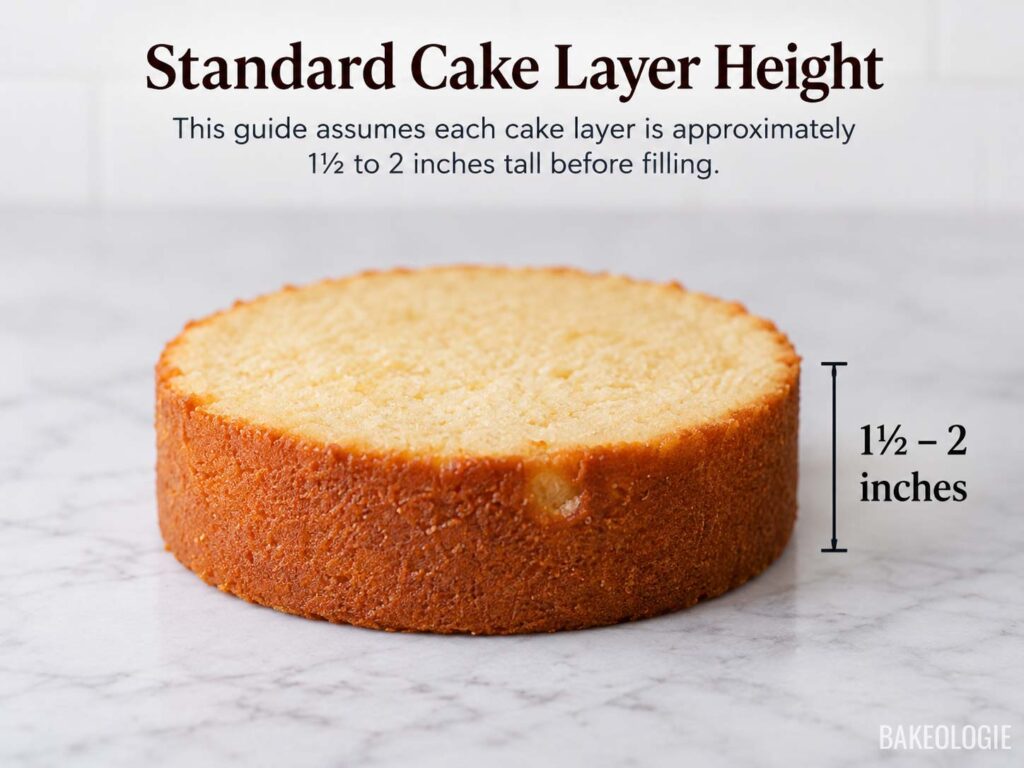
Two cakes made in the same 8-inch pans can require very different amounts of buttercream.
An 8-inch cake with two relatively thin layers might finish around 3½ to 4 inches tall. Another baker might have two full 2-inch layers and end up closer to 4½ or even 5 inches tall.
The taller cake has more side surface to cover, so it needs more buttercream even though both are technically “two-layer 8-inch cakes.”
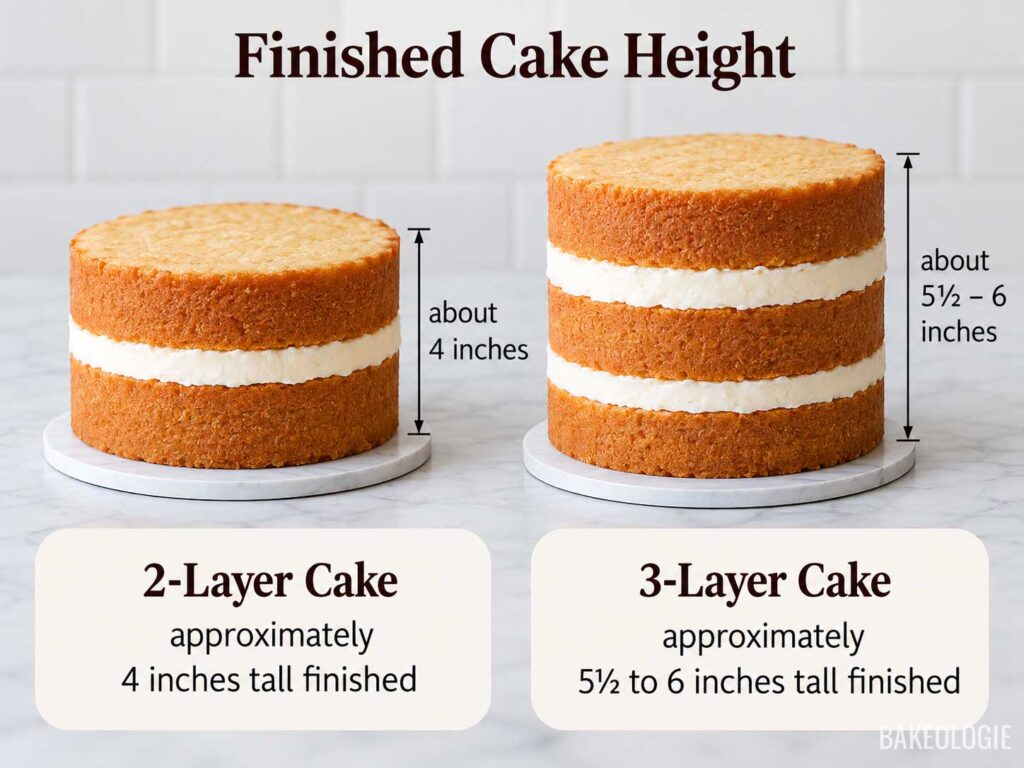
This is one reason buttercream charts from different sources often disagree. If your cake layers are especially tall, use the upper end of the range. If your finished cake is substantially taller than the chart assumption, plan on another ½ to 1½ cups, depending on the cake diameter.
How Do You Actually Measure Buttercream in Cups?
This is something that is rarely explained in buttercream charts. Should you loosely scoop buttercream into the cup? Pack it down like brown sugar? Leave all the little air pockets?
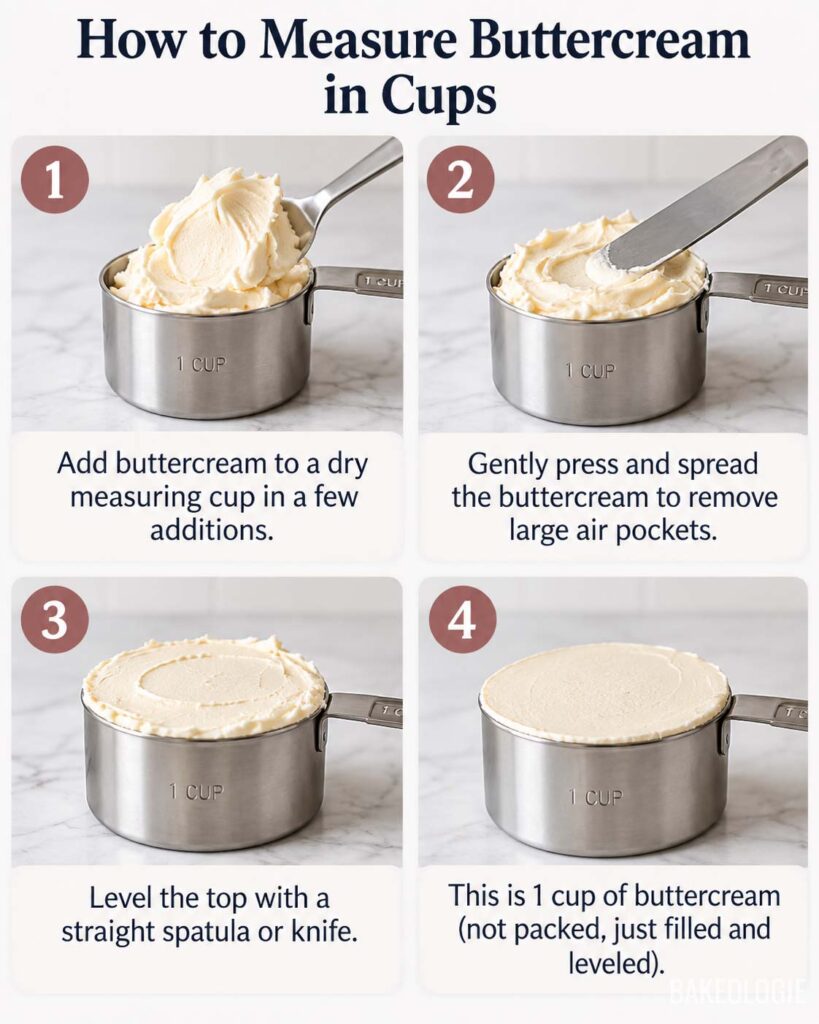
For this guide, measure buttercream using a dry measuring cup, not a liquid measuring jug.
Use a spatula or spoon to add the buttercream to the measuring cup in a few additions. As you fill it, gently spread or press the buttercream into the cup so there aren’t large empty pockets of air.
But don’t firmly compact it the way you would packed brown sugar.
You’re not trying to squeeze out the air that was naturally incorporated into the buttercream. You’re simply making sure there isn’t a large hollow pocket hiding in the middle of your measuring cup.
Once the cup is full, run a straight spatula or knife across the top so the buttercream is level with the rim.
Think: no big gaps, but not packed.
What Size Cup Am I Using?
All cup measurements in this guide refer to a US customary cup, approximately 237 mL.
This is worth mentioning because a metric cup used in some countries is 250 mL. The difference seems small, but if you measure six or eight cups of buttercream, it starts adding up.
Why Am I Using Cups Instead of Grams?
If you’ve been around Bakeologie for a while, you probably know I usually encourage you to bake by weight. So why am I suddenly giving you cups?
Because this is one situation where we’re trying to measure volume, not the amount of an ingredient needed for a baking formula.
A cake needs a certain volume of buttercream to physically fill and cover its surfaces. But different buttercreams do not necessarily weigh the same amount per cup.
American buttercream, Swiss meringue buttercream, Italian buttercream, cream cheese frosting, and other frostings have different ingredient ratios and can contain different amounts of incorporated air. Even two batches of the same buttercream can have slightly different densities depending on how they were mixed.
That means I can’t accurately tell you that “1 cup of buttercream = X grams” and have that number work for every frosting.
So while I still strongly recommend using grams to make your buttercream, cups are the more practical measurement for estimating how much frosting volume your cake needs.
I would rather give you an honest volume measurement than a gram measurement that looks wonderfully precise but may actually be wrong. In the future, I may add buttercream-specific gram equivalents after testing my own recipes individually.
Does Swiss Meringue Buttercream Need the Same Amount as American Buttercream?
By volume, you can use approximately the same cake-coverage estimate. If your cake needs 4 cups of frosting, you can plan for roughly 4 cups whether you’re using Swiss meringue buttercream or American buttercream.
By weight, however, those 4 cups may not weigh the same. That is exactly why I don’t recommend taking the cup chart above and multiplying it by a generic “grams per cup of buttercream” number.
My Quick and Easy Swiss Meringue Buttercream, for example, makes about 8 cups. Use the recipe’s stated volume yield with the chart above instead of trying to convert the batch to a universal gram equivalent.
What Do the Buttercream Amounts Include?
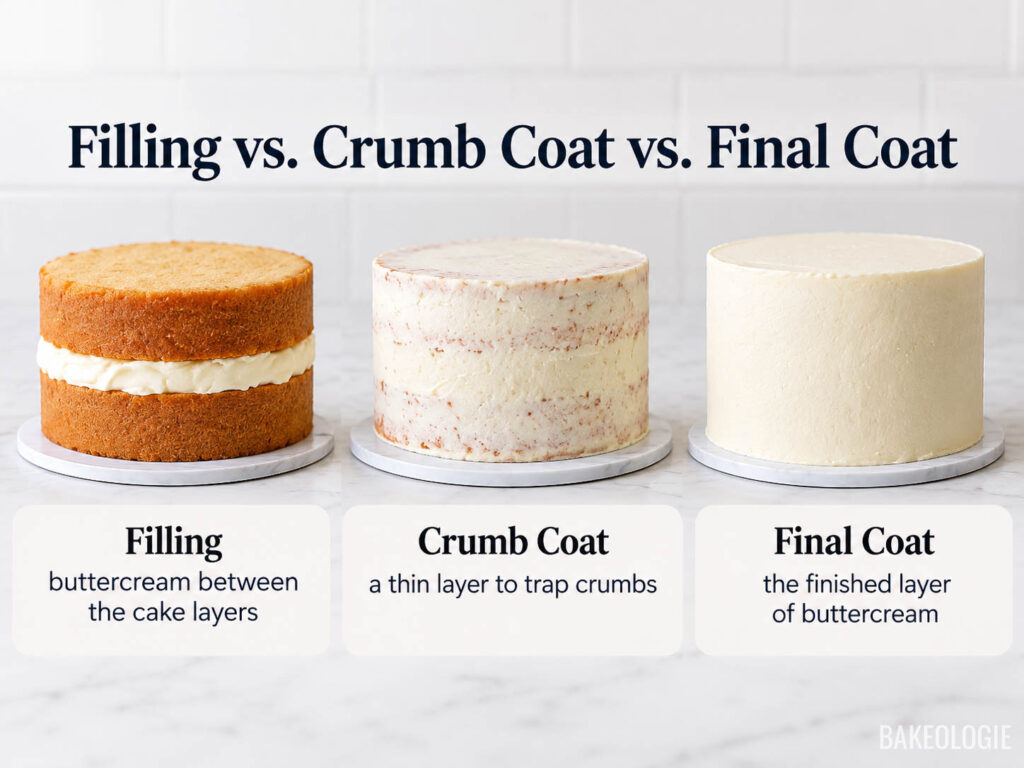
- Filling: buttercream between the cake layers.
- Crumb coat: a thin layer that traps loose crumbs.
- Final coat: the finished smooth layer of buttercream on the top and sides.
The amounts in the main chart account for all three. Decorative piping is extra.
How Much Extra Buttercream Do I Need for Decorating?
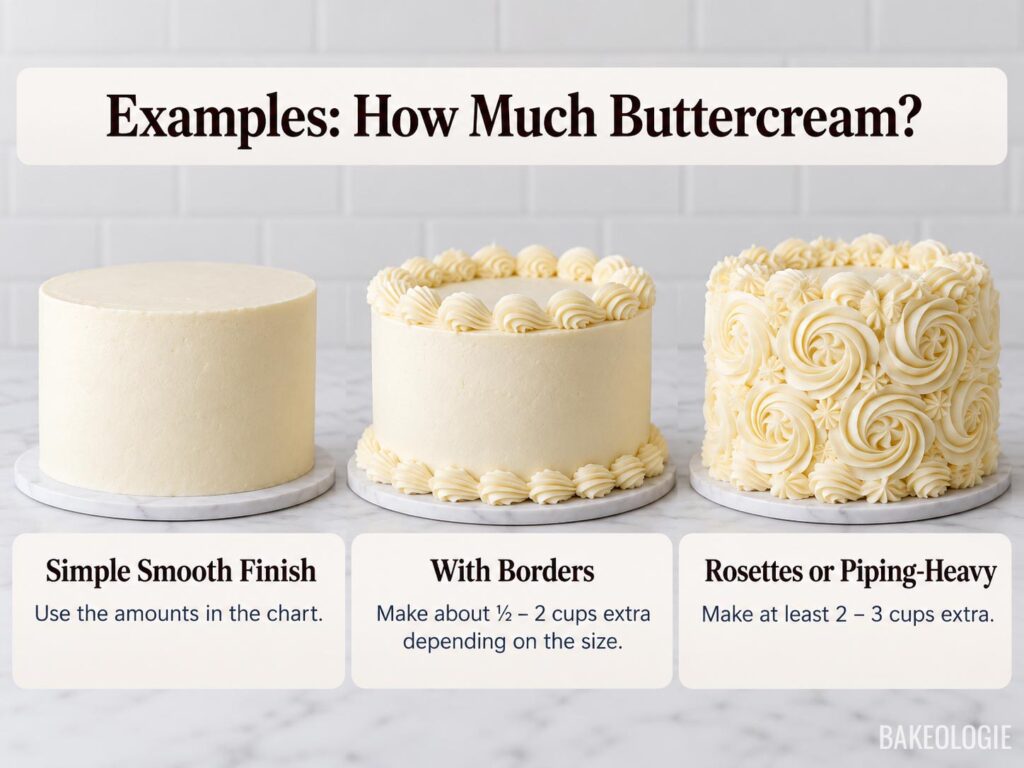
Piping can use a surprising amount of buttercream.
| Decoration | Extra Buttercream to Make |
|---|---|
| Small writing or simple details | about ½ cup |
| Simple border | about ½–1 cup |
| Larger piped border | about 1–2 cups |
| Large swirls on top | about 1–2 cups |
| Rosettes covering a 6–8 inch cake | about 2–3 cups |
| Heavy vintage or Lambeth piping | at least 2–3 cups extra |
If your decoration requires several colors, I also prefer making a little extra. Every piping bag and mixing bowl holds on to some buttercream, and those little amounts add up.
What If I’m Using a Different Filling Between the Cake Layers?
Good news: you probably need less buttercream.
If you’re filling your cake with ganache, pastry cream, fruit filling, curd, jam, or another frosting, you don’t need to make the full buttercream amount intended for filling and covering.
However, don’t automatically cut the total amount in half. Your cake still needs enough buttercream for the crumb coat and exterior.
What About a Semi-Naked Cake?
A semi-naked cake uses much less buttercream on the outside because most of the final coat is scraped away until portions of the cake show through.
But don’t simply halve the entire amount if you’re also using buttercream between your layers. Your filling requirement stays the same; what you’re reducing is mostly the final exterior coat.
How Much Buttercream for a Square Cake?
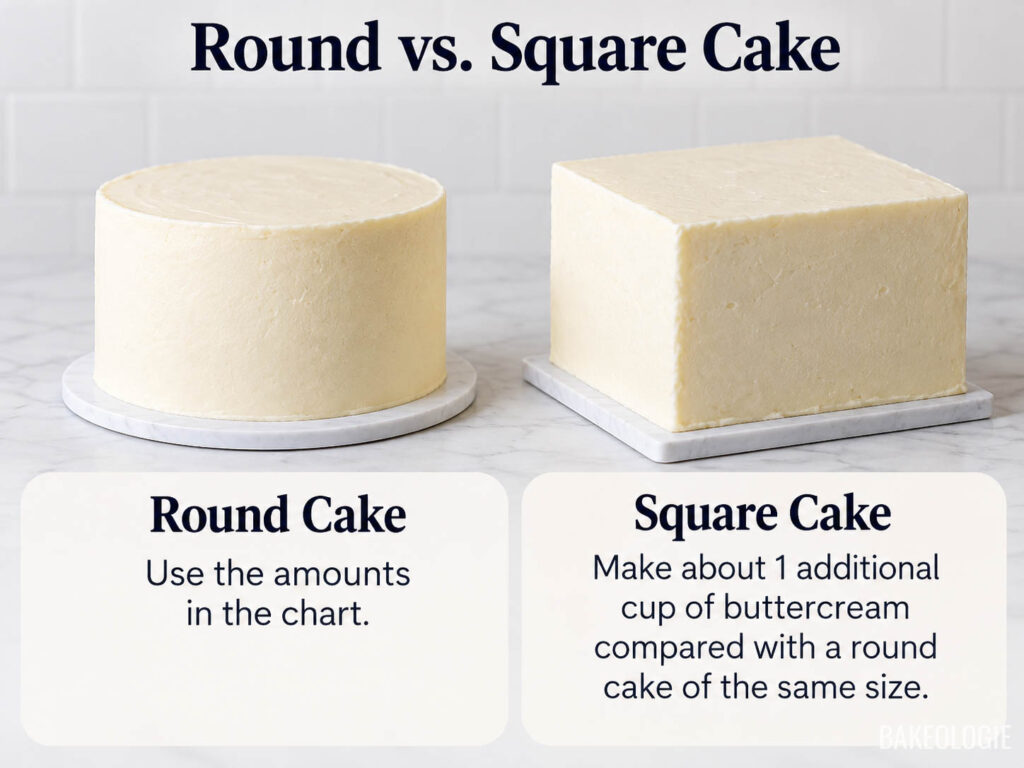
Square cakes have more surface area than round cakes of the same width, plus four corners that need to be covered and smoothed.
As a simple starting point, make about 1 additional cup of buttercream compared with a round cake of the same size. For very large cakes, err more generously.
How Much Buttercream for a 9×13 Cake?
This depends heavily on whether you mean a simple single-layer sheet cake or a stacked and filled cake.
For a standard single-layer 9×13-inch cake, around 2½ to 3 cups is usually enough for a typical frosting layer.
A two-layer 9×13 cake that is filled and frosted on the top and sides is an entirely different cake. Plan on about 7 to 8 cups for a standard smooth finish, and make more if you use a thick filling layer or decorative piping.
How Do I Figure Out How Many Batches of Buttercream to Make?
Once you know how many cups your cake needs, check the yield of your buttercream recipe.
Buttercream needed ÷ recipe yield = number of batches needed
For example, if your cake needs 6 cups and your buttercream recipe makes 4 cups:
6 ÷ 4 = 1.5 batches
You would make one and a half times the recipe. If your recipe gives ingredient weights in grams, this is where your digital scale becomes your best friend: multiply every ingredient weight by 1.5 instead of trying to eyeball awkward partial measurements.
What If My Buttercream Recipe Only Gives the Yield in Grams?
Don’t use a random online grams-per-cup conversion. Instead, establish the conversion for your particular buttercream.
- Make the buttercream normally.
- Measure one cup using the method described earlier: fill the cup without firmly packing it, remove obvious air pockets, and level the surface.
- Weigh that cup.
- Divide the total weight of your batch by the weight of one measured cup.
For example, if one properly measured cup of your finished buttercream weighs 205 grams and your entire batch weighs 820 grams, then 820 ÷ 205 = 4 cups.
If you make cakes regularly, write that yield directly on your recipe. Future You will be very pleased with Present You.
How Much Buttercream Do I Need for Cupcakes?
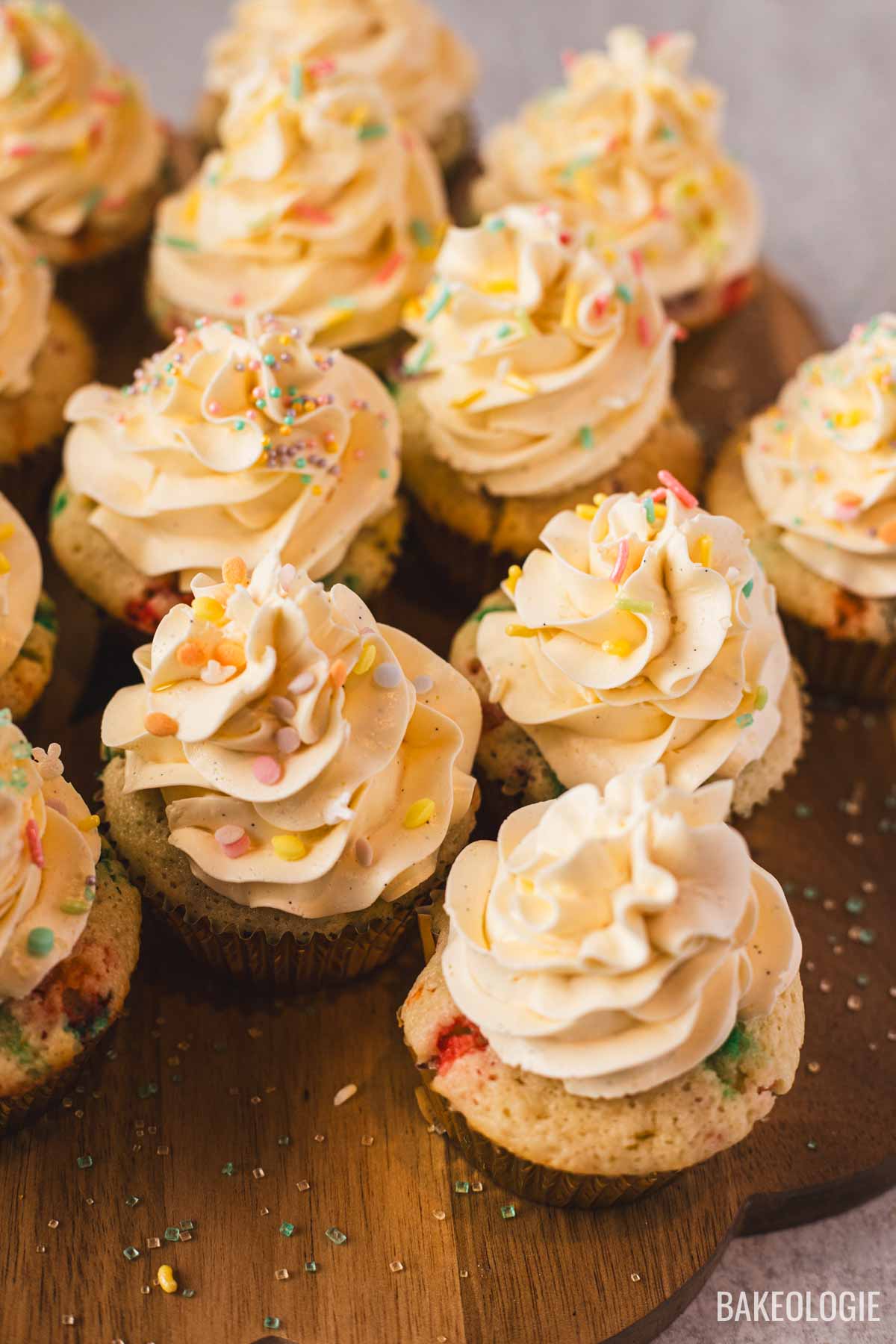
As a rough guide, allow around 1½ cups for 12 cupcakes if you’re spreading frosting on with a spatula, about 2 cups per dozen for piped rosettes, and approximately 2½ cups per dozen for large bakery-style swirls.
The piping tip and height of your swirl make a surprisingly big difference.
My Best Advice: Make a Little Extra
Buttercream charts are guides, not guarantees.
Your cake layers may be taller than mine. You may like thicker filling. You may scrape away more buttercream while trying to get perfectly smooth sides. You may decide halfway through decorating that the cake obviously needs twelve extra rosettes because apparently we’re committed now.
For that reason, I generally prefer having ½ to 1 cup extra for a standard layer cake. If I’m doing significant piping, I plan for even more.
And remember: leftover buttercream is a considerably easier problem to solve than a half-frosted cake.
Buttercream Recipes to Try
If you’re ready to frost your cake, these are some of my favorite buttercream recipes:
- Quick and Easy Swiss Meringue Buttercream — my shortcut faux Swiss meringue buttercream that is silky, smooth, not overly sweet, and makes about 8 cups.
- Classic Swiss Meringue Buttercream — the traditional method for a smooth and silky buttercream.
- Swiss Meringue Buttercream with Carton Egg Whites — useful if you want traditional Swiss meringue without separating a pile of eggs.
- Champagne Buttercream — a Swiss meringue-style buttercream for celebrations and special-occasion cakes.
And if you’re deciding what cake to put underneath all that buttercream, my Sturdy Yet Moist Chocolate Cake and Fluffy and Buttery Vanilla Cake are both designed for layer cakes and stacking.
Frequently Asked Questions
Can I convert the buttercream chart from cups to grams?
Not accurately with one universal conversion. Different buttercreams have different densities, and the amount of air incorporated during mixing affects how much a cup weighs. If you want a gram conversion, weigh one properly measured cup of the specific buttercream you’re using.
Should buttercream be packed into the measuring cup?
No. Gently press and spread it into the measuring cup to remove large empty spaces, but don’t firmly compress it like packed brown sugar. Level the top with the rim of the cup.
Does one cup of Swiss meringue buttercream weigh the same as one cup of American buttercream?
Not necessarily. They occupy the same volume — one cup — but their weights can differ because their ingredients and densities are different.
Should I include the crumb coat when calculating buttercream?
Yes. The round-cake chart in this guide includes a thin crumb coat.
What if I’m filling the cake with ganache, jam, curd, or pastry cream?
You’ll need less buttercream because you aren’t using it between the cake layers. Keep enough for the crumb coat and exterior, then reduce the amount that would otherwise be used as filling.
What if my cake is taller than normal?
Use the high end of the recommended range and make additional buttercream if necessary. This chart assumes about 4 inches finished height for a 2-layer cake and 5½ to 6 inches for a 3-layer cake.
Is it better to make too much buttercream?
Within reason, yes. An extra ½ to 1 cup gives you room for smoothing, corrections, and small decorations. If you’re doing a piping-heavy design, make more.