

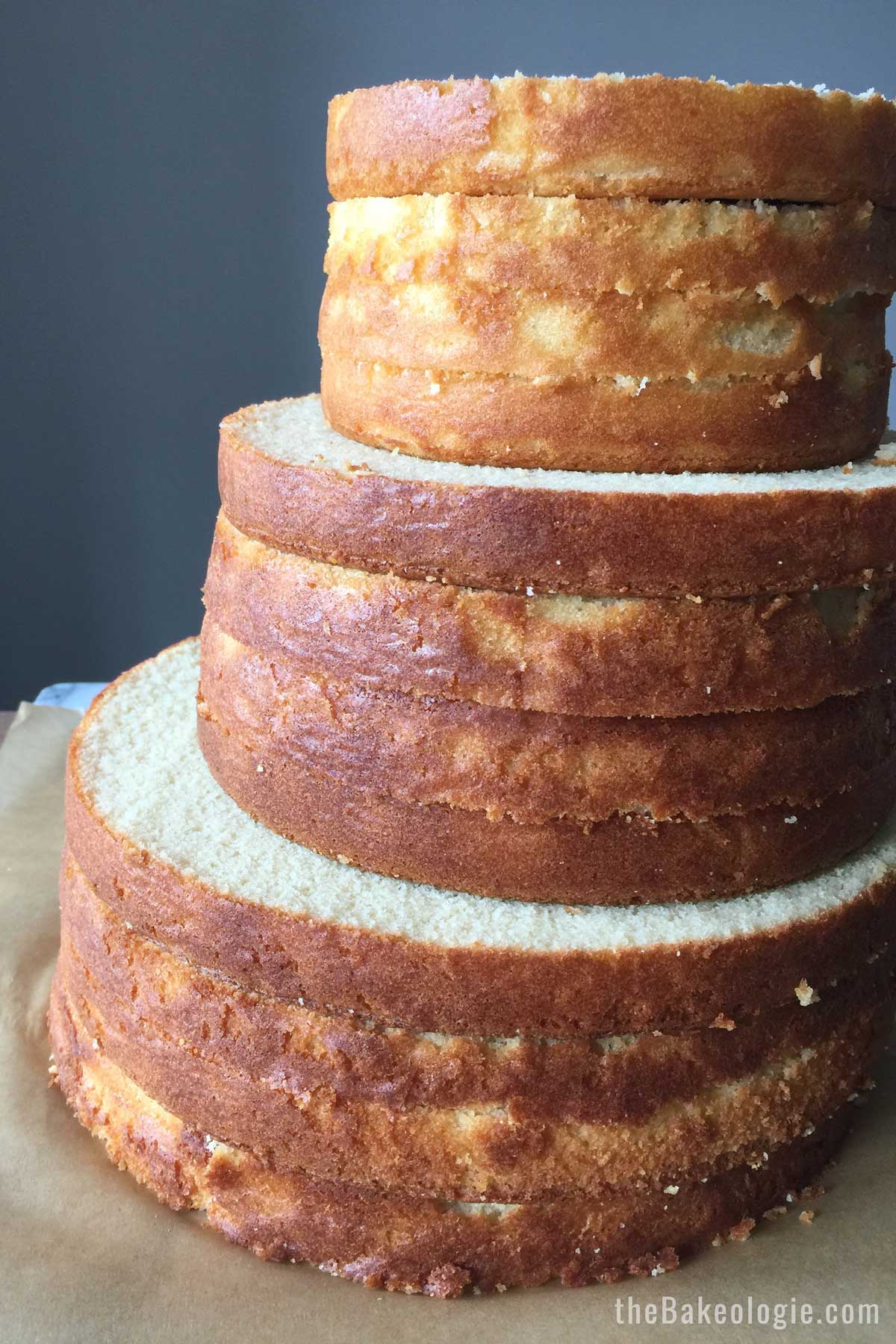
Made from scratch basic Vanilla Cake that yields tall and sturdy cake layers that are great for stacking tiered cakes. It’s buttery, tender, and full of vanilla flavor – a great base cake for all occasions!
Do you need the chocolate version? Head on to Sturdy Yet Moist and Fluffy Chocolate recipe.
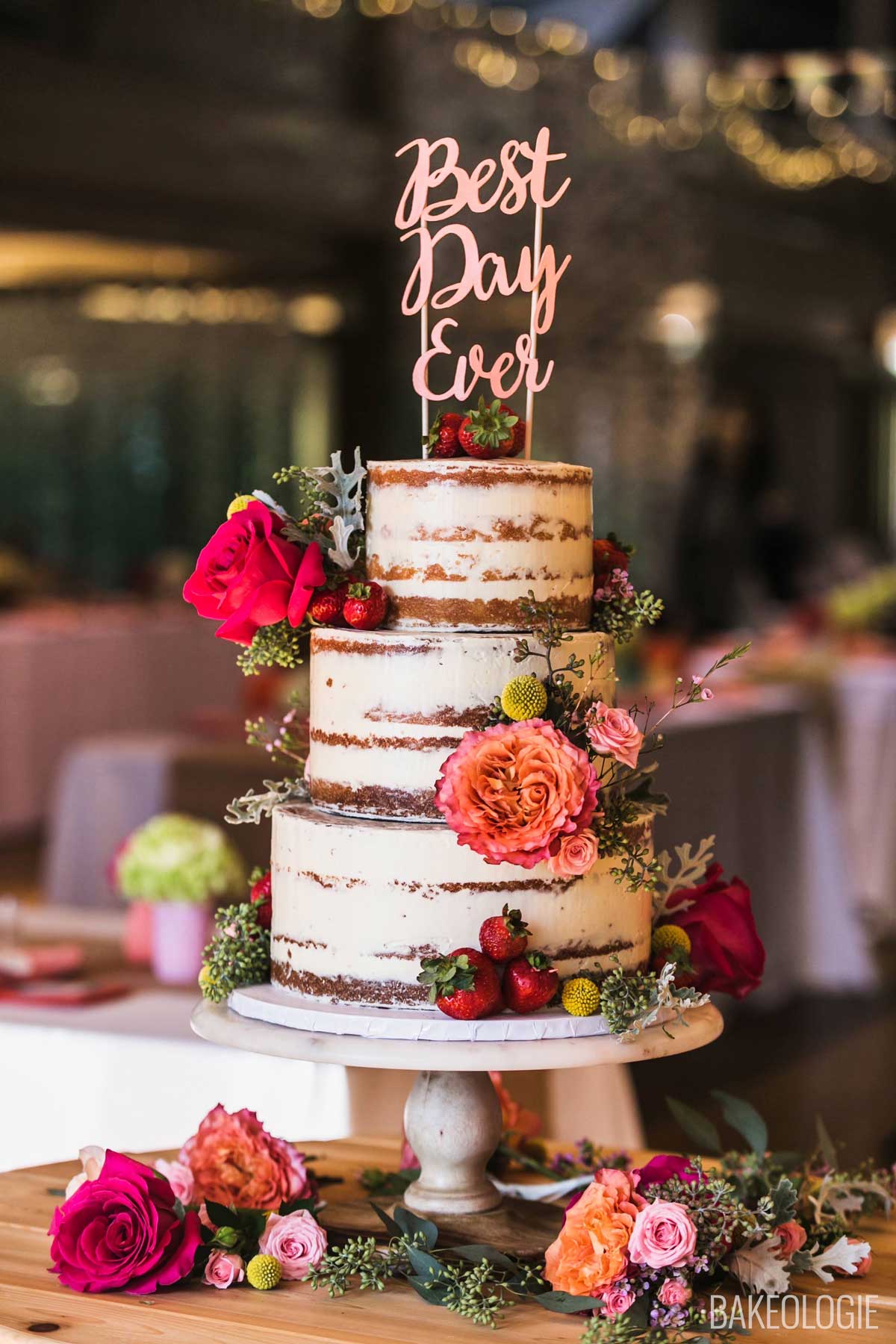
Great for Wedding Cakes and Tiered Cakes (for Stacking and Carving)
I’ve been looking for a great basic vanilla cake that can be my go-to vanilla cake recipe whenever I make tiered cakes. I tried many and never found one that is for keeps, until now.
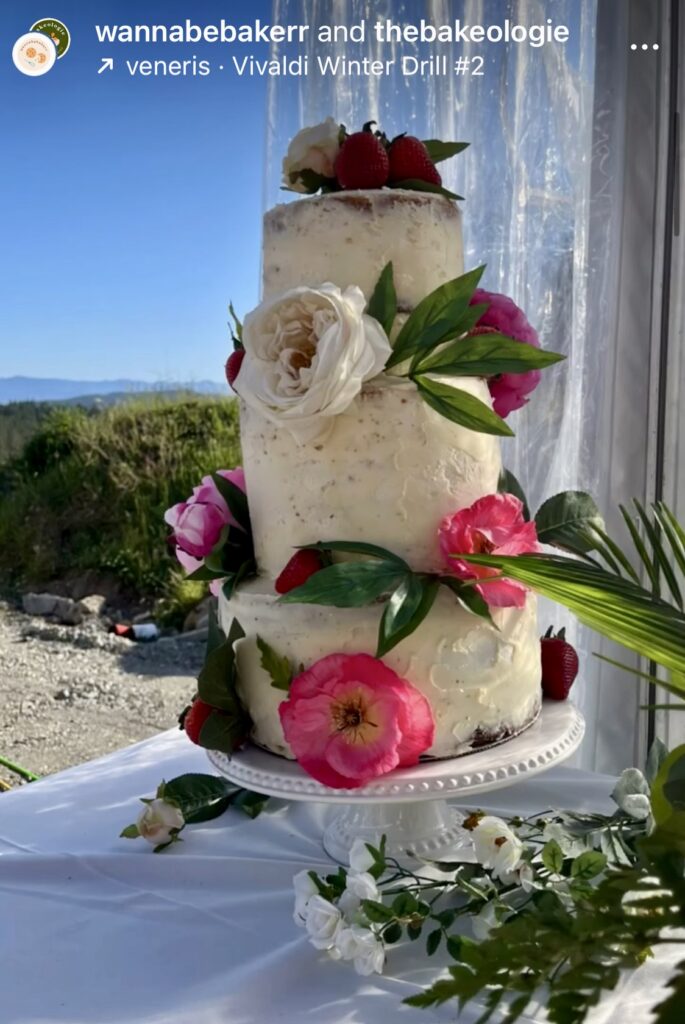
I’ve used this recipe to make a 3-tiered wedding cake so I can say that while it is soft and fluffy, it is firm enough to use in multi-tiered cakes. As we know, for tiered cakes, it is suggested to stay clear of softer, less stable cakes and filling like chiffon cake, pastry cream, and whipped cream.
Are you thinking of doing a DIY wedding cake? I’ve shared all the recipes, timeline, resources, and tips in this DIY Wedding Cake post.
Thick layers for Tall Cakes
This recipe yields a tall vanilla cake, that’s why you would need a cake pan that is at least 3 inches in height.
If you don’t have a tall cake pan, you can line some parchment paper around the pan for extra height.
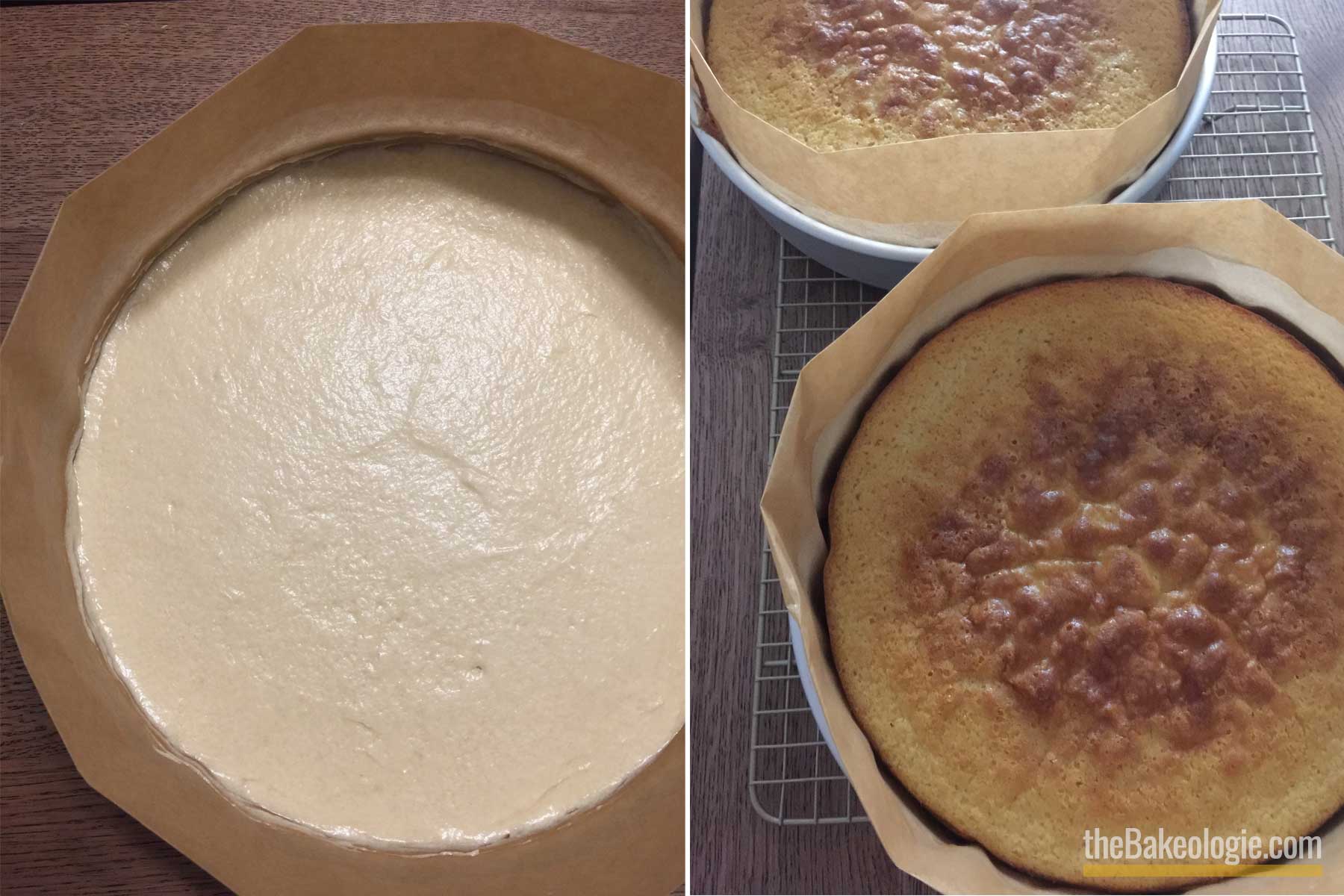
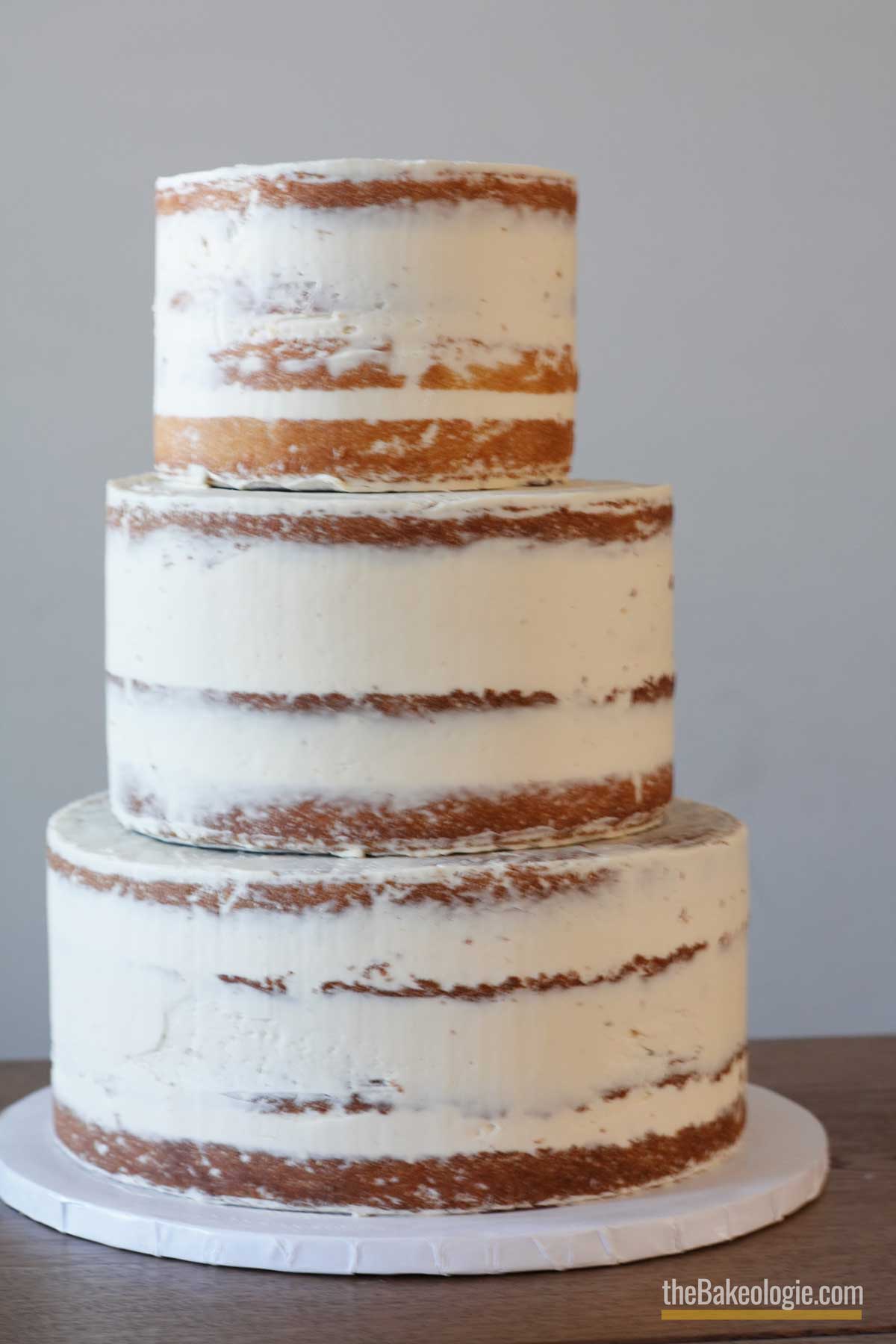
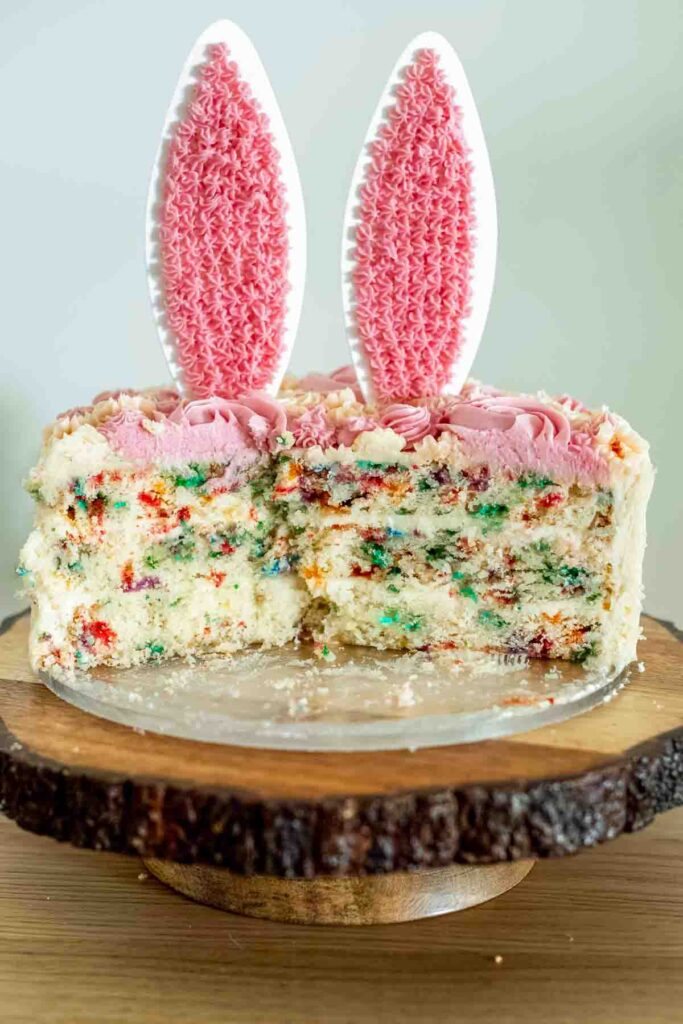
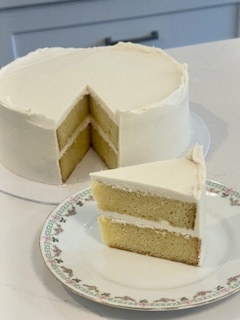
The photos you see here were taken while I was doing my final cake for my cousin’s wedding. Unfortunately, I have forgotten to take a photo of the cake right out of the cake pan.
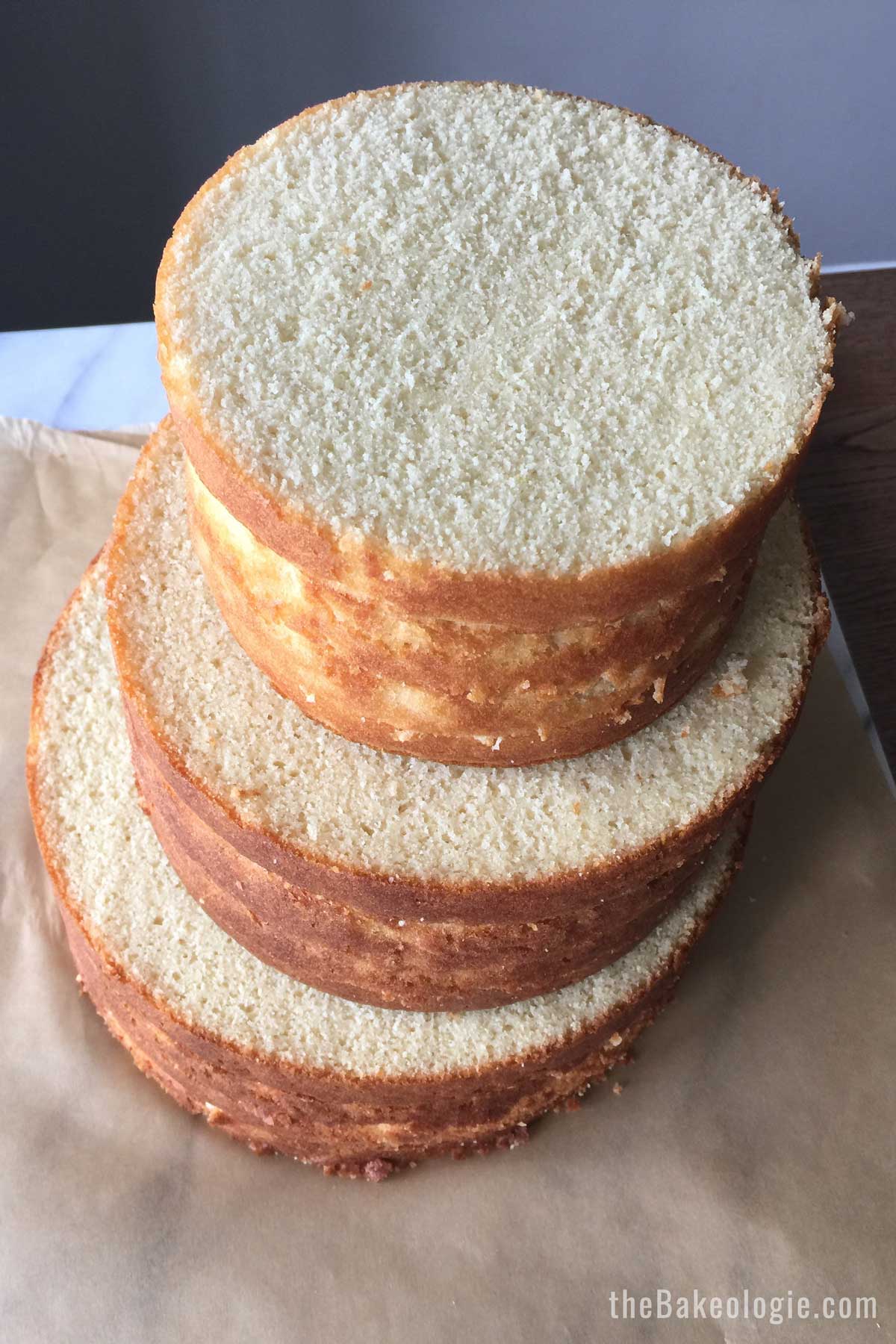
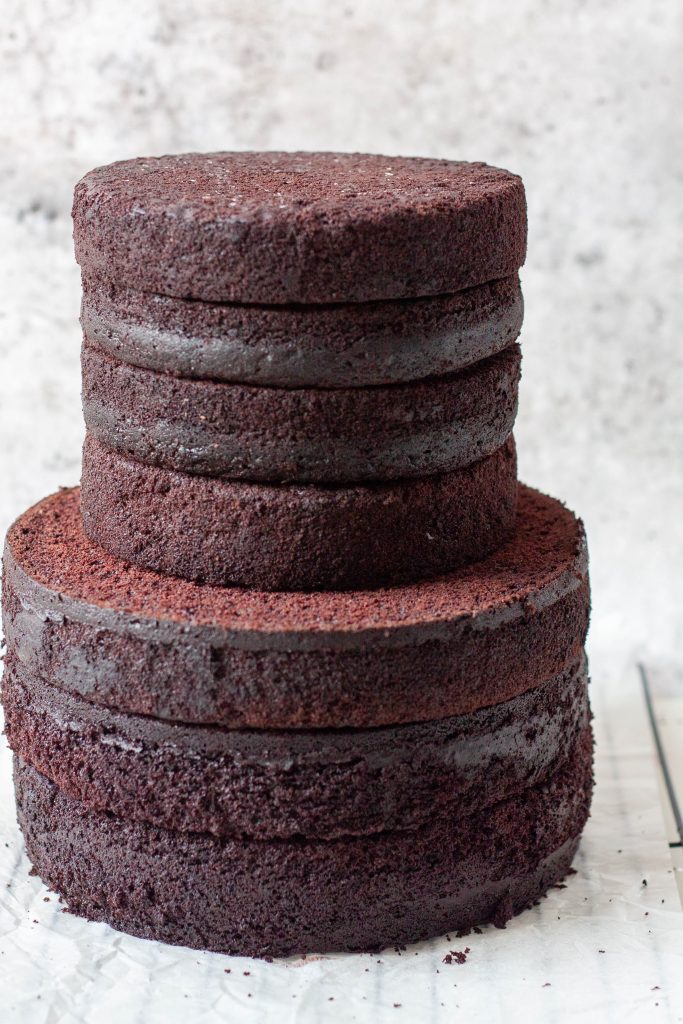
I then further cut each round into half to give me a total of 4 layers, which is what you see in the photos.
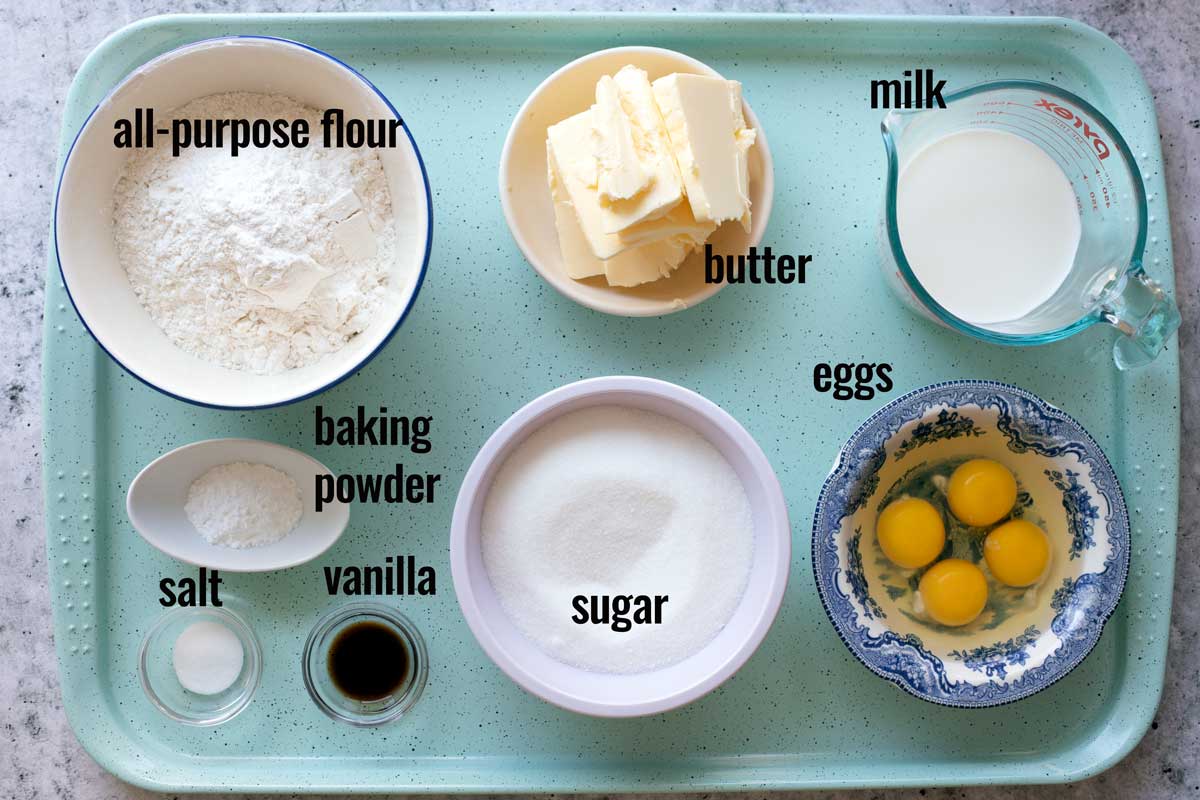
Ingredients for Vanilla Cake
- all-purpose flour
- baking powder
- fine salt
- unsalted butter at room temperature – What is room temperature butter?
- granulated white sugar
- vanilla extract
- eggs (large size) at room temperature
- fresh milk (whole / full-fat)
Tools and equipment you’ll need
Ditch your cups and weigh your ingredients – it will give you consistent results every time. Try it and you will never look back on using cups again!
There are a lot of reasons why you should measure by weight and entirely a topic of its own. This recipe uses a lot of flour – measuring it incorrectly would greatly affect the outcome of your cake.
I use and recommend Fat Daddios brand. They heat faster and cools quicker, preventing overbaking. It has straight sides for perfect layers!
If your existing pan’s height is below 3 inches, see recipe note no. 1.
- parchment paper
- flour sifter or a fine mesh strainer
- stand mixer
- toothpick or cake tester
Instructions
Preparation:
- Preheat your oven to 350 F (180 C).
- Make sure your ingredients are at room temperature.
- Grease the bottom of two 8x 3 round pans, then line with parchment paper (Note 1 in recipe card).
Make the vanilla cake batter:
Making this cake involved 3 parts: Creaming the butter and sugar, adding the eggs, and adding the remaining dry and wet mixtures alternately.
In a bowl, sift all the dry ingredients together: flour, baking powder, and salt. Set aside.
In a stand mixer bowl, cream butter, sugar, and vanilla on medium speed until light and fluffy, about 5-8 minutes.
RELATED: Stand Mixer Speed Guide
Add eggs to the mixture, two at a time. Blend until incorporated and scrape the sides as needed.
Add the flour mixture in four parts alternating with the milk in three parts, starting and ending with the flour mixture. Remember to add the next flour or milk until just incorporated; be careful not to overmix!
Bake the vanilla cake
Pour the cake batter into prepared pans and spread it so that is it smooth and flat in the pans. Bake until a toothpick inserted in the center comes out clean, about 60 minutes.
Cool the cakes on a wire rack before removing them from the pan.
Torte each cake into 2 to get 4 layers like in the photo below.
Watch How To Make This Sturdy Yet Moist Vanilla Cake
FAQs
Do I really need to sift the dry ingredients?
The process of sifting breaks any lumps in flour that would weigh down the batter so your Vanilla Cake will yield a tender (not delicate) crumb. When flour is sifted with other dry ingredients, such as baking powder, sifting helps to combine them evenly before they are mixed with other ingredients. It is important not to skip this step!
Why do I need to cream the butter and sugar?
When creaming the butter and sugar together, the sugar is like punching little holes in the butter and those holes, in turn, will capture air. These little bubbles capture the gases released by your leaveners when baked, giving your cake a lighter texture. A properly creamed butter and sugar should have the color of pale yellow, not white.
Using a stand mixer, I typically whip the butter and sugar on medium speed for 5 minutes.
My cake came out dry – What did I do wrong?
There are several possible reasons why your cake came out dry. One common mistake is NOT measuring your flour correctly. If you’re still using cups to measure your flour and other baking ingredients, I can’t emphasize enough the importance of using a food scale !
Baking is an exact science, so one ingredient that’s not measured correctly can totally break the outcome.
Another common reason is overcooking them. As not all ovens are the same, remember to treat the cooking time stated in any recipe as a guide.
Your cake is perfectly done and needs to be removed from the oven when the toothpick/ cake tester comes out either clean or with a few dry crumbs.
Always begin checking your cake at the earlier doneness time specified in the recipe. I like to set my timer a few minutes earlier than the shortest baking time called for.
You can always bake something longer, but over baked or burnt products are ruined! Always check for doneness about 5 minutes before the suggested bake time.
How Can I Make This Ahead?

After the cakes have been removed from the pan and have completely cooled down. Double wrap each layer with plastic/saran wrap and keep in the fridge for up to 2 days. I did this when I used this recipe for a wedding cake.
If longer than 2 days, I suggest keeping them in the freezer instead. If freezing, double wrap it with plastic/saran wrap then wrap again in foil. The first layer keeps the cake tight and fresh and the aluminum foil ensures no condensation will seep in.
When you are ready to use the cake, transfer the wrapped cakes from the freezer to the refrigerator one day before assembling. Take them out of the freezer container to thaw, but leave them wrapped in plastic wrap/aluminum foil.
The cakes take at least 8 hours to thaw completely in the refrigerator. Make sure you’re thawing the cakes while they’re still in the wrapping. Condensation forms as foods thaw. This way the condensation will form on the wrapping, not the cake.
Can I Make This Into Cupcakes?
One of the most frequently asked questions – How do I turn this cake into a cupcake? Simply half the recipe of the 6-inch vanilla cake to get about 12 cupcakes.
I did the math for you!
To make 12 cupcakes (50g of batter for each cupcake), you’ll need:
- 175 grams all-purpose flour
- 1 teaspoon baking powder
- 1/4 tsp regular table salt
- 130 grams unsalted butter
- 150 grams granulated white sugar
- 1/2 teaspoon vanilla extract
- 2 large eggs (about 100g without shell)
- 140 grams whole milk
For cupcakes, bake at 350F for about 15-17 minutes.
Adapting This Vanilla Cake to Different Pan Sizes
The photos you see at the beginning of this post are the 6-inch, 8-inch, and 10-inch vanilla cake, with all the layers sliced and leveled.
Here is a chart of the amount of ingredients you’ll need depending on pan size.
NOTE: This is on the assumption that the height of the cake remains the same – only the circumference of the pan changes.
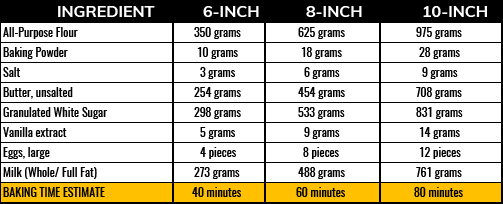
Batter Weight (before baking): 6-inch is around 1,310 grams, so 655 grams of batter per pan.
Follow the same procedure as written in the recipe but you may need to adjust the baking time. Remember that the time indicated below is only a guide as not all ovens are the same.
It is a good habit to check for doneness 5 minutes earlier than the shortest baking time called for. If the cake isn’t done yet, check again after 3-4 minutes.
Recipe for round cakes from 4-inch up to 12-inch pans
This Fluffy and Buttery Vanilla Cake is one of the most popular recipes at Bakeologie . Over the years, a lot of people made and loved this cake and have been asking how to make it in different sizes.
I’ve put together a resource with all the ingredient quantities for round cakes from 4-inch up to 12-inch. Now, no more guesswork!
NEW!!! Chocolate version is now available here.
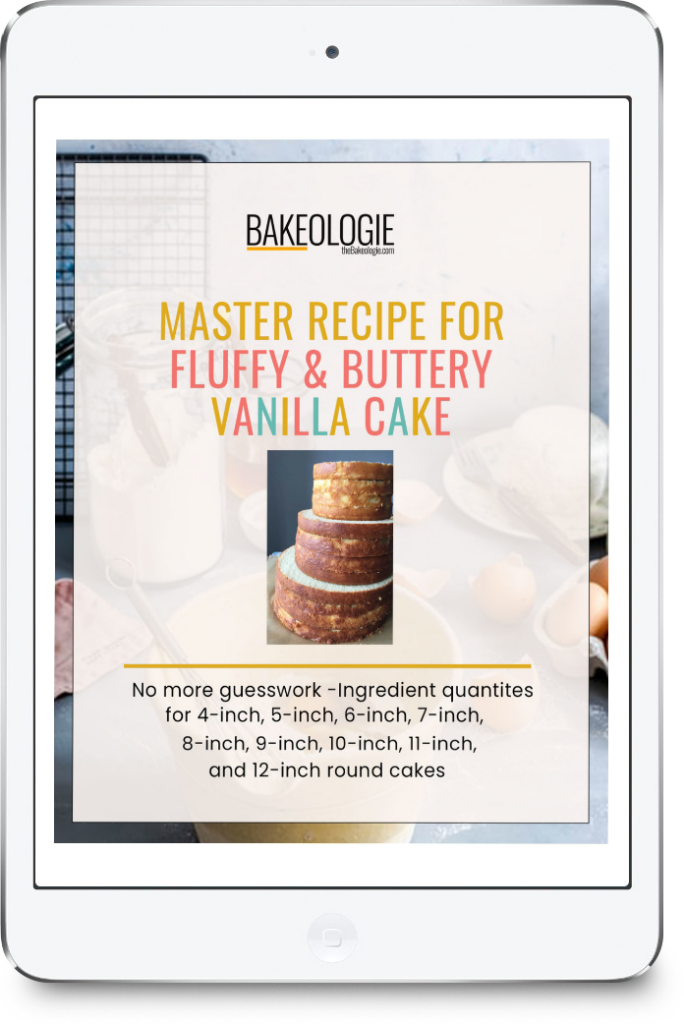
If you have tried this recipe and wanted to make it in other different sizes , this is the answer for you!
Check out my shop page or grab the Master Recipe for Fluffy and Buttery Vanilla Cake directly through this link.
What Frosting Goes Well With This Cake?
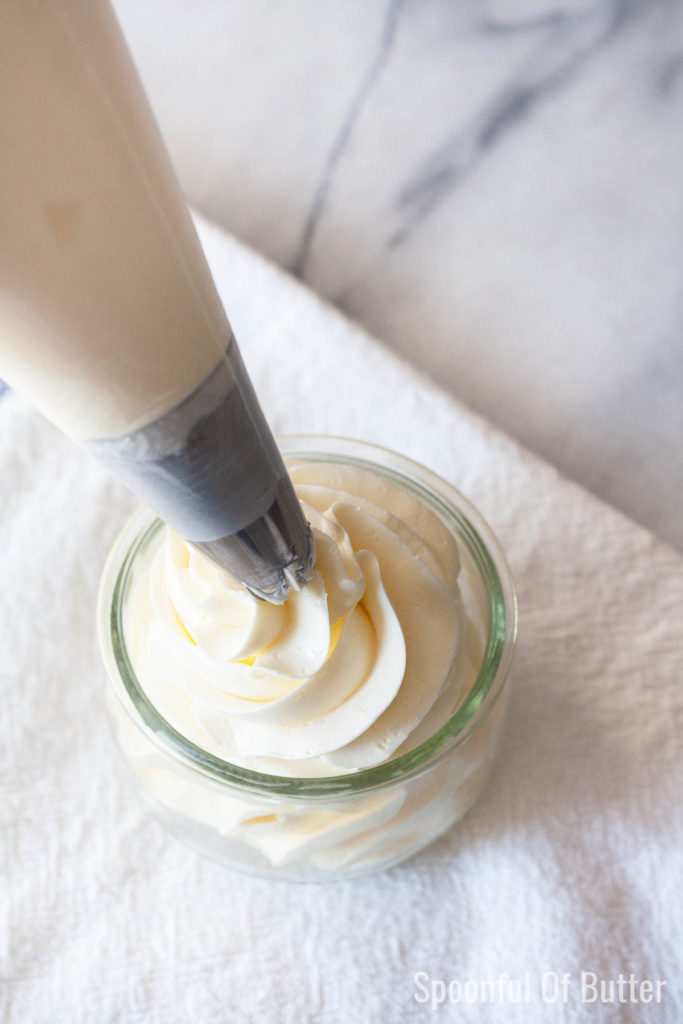
I recommend pairing this vanilla cake with swiss meringue buttercream. I love swiss meringue because it’s smooth, silky, and not tooth-achingly sweet! It can be used on a variety of cakes and cupcakes as it can easily be flavored.
How Much Buttercream Do I Need?
Once you know your cake size and number of layers, use my buttercream cake size chart to estimate how much you’ll need for filling, crumb coating, and frosting.
❤️ Tried this recipe and loved it? If you made this recipe or any other recipe on this site, please leave a ⭐️⭐️⭐️⭐️⭐️ rating + review below – or tag @thebakeologie on Instagram and hashtag it #bakeologie !

Fluffy and Buttery Vanilla Cake
INGREDIENTS
- 625 grams all-purpose flour (22 oz )
- 18 grams baking powder (1 tablespoon + 2 teaspoons )
- 6 grams salt (1 teaspoon)
- 454 grams butter, unsalted, at room temperature (16 oz )
- 533 grams white granulated sugar (19 oz )
- 9 grams vanilla extract (2 teaspoons )
- 400 grams eggs (weight is without shell) (approx 8 large eggs) at room temperature
- 488 grams whole milk (17.2 oz )
INSTRUCTIONS
- PREPARATION. Preheat oven to 350 F (180 C). Grease the bottom of two 8x 3 round pans, then line the bottoms with parchment paper (Note 1).
- PREPARE THE DRY INGREDIENTS. In a bowl, sift all the dry ingredients together: flour, baking powder, and salt. Set aside.625 grams all-purpose flour18 grams baking powder6 grams salt
- CREAM THE BUTTER, SUGAR AND VANILLA. In a stand mixer bowl, cream butter, sugar, and vanilla on medium speed until light and fluffy, about 5-8 minutes.454 grams butter, unsalted, at room temperature533 grams white granulated sugar9 grams vanilla extract
- ADD EGGS TO THE MIXTURE. Add eggs to the mixture, two at a time. Blend until incorporated and scrape the sides as needed.400 grams eggs (weight is without shell)
- ADD THE DRY AND WET INGREDIENTS. Add the flour mixture in four parts alternating with the milk in three parts, starting and ending with the flour mixture. Remember to add the next flour or milk until just incorporated; be careful not to overmix!488 grams whole milk
- BAKE THE VANILLA CAKE. Pour the cake batter into prepared pans and spread it so that is it smooth and flat in the pans. (I weigh the batter and divide it into 2 so each pan would have the exact amount.) Bake until a toothpick inserted in the center comes out clean, about 60 minutes. Cool the cakes on a wire rack before removing them from the pan. Divide each cooled cake into 2 to get 4 layers.
NOTES
Whisk, Snap, and Share
This space isn’t just for our photos — We’d love to feature yours too! If you’ve made this recipe, tag us on Instagram @thebakeologie or email your photo to [email protected] with the recipe name in the subject line.
📸 By sending a photo, you’re giving us permission to feature it here.


Hi.. Would this work with Almond milk instead of whole milk?
I have not tried this recipe other than whole milk, sorry. I would love to know the results in case you give it a try! Thank you.
I need this recipe for a 12 inch cake. Can you please help?
Sorry, I haven’t tried making this in 12-inch size yet!
We used this and your chocolate cake recipe for our wedding cake (one layer of each). It was absolutely delicious! It’s so light and fluffy. I don’t usually love vanilla cake, but this was outstanding! It was also easy to work with! We made a couple test runs, and they turned out well each time.Thank you so much!!
Cassidy, thank you so much for taking the time to leave a rating and review – this helps me a lot! For a non-vanilla cake lover, I am ecstatic that you have enjoyed both cake recipes. They are truly a keeper! 🙂
I’m sure I looked over it, but do you know how many people a 2 tiered cake would feed? I plan to do the 8 inch and 6 inch for my daughter’s birthday.
Hi, Alena! I think it depends on how you would slice (serving amount) the cake too. Here’s a link that may be helpful for you. https://blog.wilton.com/cake-baking-serving-guide/
Just finished baking the cake. Turned out perfect and smells divine. This is a great recipe! Looks sturdy enough for such a big cake. Thank you for sharing!
That’s awesome, Angelina! Thank you so much for leaving a rating and review!
Hello I was just wondering how many batches you used to fill each individual cake layers? Like the 10”,8”,6”
Hello! I am not sure if I understood your question correctly. I used 1 batch (which is the recipe above) for each of the tier (6, 8, 10 inch). Each batch yields 2 tall cakes, which I further sliced to get 4 layers per tier.
Dear Trish I tested three recipes and yours was by far the best. The wedding cake I am attempting to make for a friend has slightly different dimensions. I will use the 6 inch size, but want to do a 9inch (instead of 8inch) and a 12inch (instead of 10inch). I thought calculating the quantity of ingredients for the extra sizes would be easy/straight forward but it’s not:) Do you have a formula or suggestion for me? Thank you so much and for giving me the confidence to tackle this project. Clea
Hello, Clea! Thank you for trying my recipe – I am glad you liked it! =) Recipes from 4-inch up to 12-inch are available as an ebook resource here.
Hi, I was wondering if you could flavour those cake slightly differently? Or if it would ruin the texture and consistency. I am trying to find a lemon Rosemary cake to make for a friends wedding coming up. So I am wondering if I can take a vanilla cake and add lemon and rosemary to it? 🤷♀️ Thanks!
Hi, Melissa. You can try adding about 20g of lemon zest and about a teaspoon of lemon extract to the milk. You can also try to experiment adding lemon juice – but it might throw off the balance between wet and dry ingredients (affecting the texture and consistency) so you might need to do some tweaking. Lemon and rosemary sounds delicious!
Hi there! This cake is turning out beautifully – thank you for sharing the recipe! I’m trying to covert it for 9in round pans – do you have any advise on the calculation for that? I used the 8in by 2.25 to covert to 12 and that turned out great so far!
Hello! I’ve baked the top tier so far and the cake tasted great, lovely consistency for fondant. Thank you for sharing. I don’t think I’ve got the oven temp right though – it domed, cracked, and I’ll have to cut quite a bit off. I used cake protectors. Is the 175C a standard or fan-assisted temp? I’ll check my oven first for the next layer too. Thanks.
Thank you for your review, Kate! 350 F/ 175C is for a conventional oven (no fan). If using a convection oven, reduce temp by 25F. It may also due to an off oven temperature, are you using an oven thermometer? Place the thermometer near where you would be placing your cake pans to see if you have the correct temp. I discovered mine is 10 F hotter!
My question is do you apply room temperature frosting on room temperature cakes ? Or do u recommend to put cakes in fridge for a while ? If so how long before icing them ? I feel like my frosting always soft even though I’ve done a thicker frosting. Please help !!! 🙂
Hi, Suzana! I frost my cakes either at room temperature or from the fridge when I bake the cake layers a day before. You can choose to put the cake in the fridge for a few hours (about 2 hours I would say) so it is easier to handle and frost them. What kind of frosting are you trying to make? Buttercream should really be soft and smooth but should hold up its shape when piping. If it’s too runny then one reason can be the butter you used might be too soft/warm, or you need more powdered sugar.
Hi Trish
I’ve made the chocolate version of your recipe and it’s incredible. Question on the 10inch pan, do you know how I’d calculate it using one pan to get 4 layers? Or is it just best to get a 2nd tin? My cupboard space is limited so was hoping to keep to just 1 pan haha silly I know.
Or is it simple double the mix but increase the baking time?
Thanks
Louise
Hello, Louise! I recommend getting a 2nd tin. Putting a lot of batter in 1 deep cake pan (e.g. 10×3 or 10×4) would mean longer baking time – which also means the outer cake will come out drier because they are the ones that get to finish baking first. Some use a heating core to help bake the cake evenly but note that your heating core should be as tall as the height of your batter when it is in the pan. Sorry, I don’t much experience on this one!
I am new to measuring ingredients. When you say sift dry ingredients together, do you mean weigh them first and then sift them together?
Hi, Amanda – you are correct. Weigh your ingredients first before sifting them.
Thank you! Also, I was wondering, can this be made in advance and frozen, and would it work well with raspberry filling?
Thank you. Can this cake be made ahead of time and frozen. Also, does it work well with raspberry filling?
Yes, this can definitely be made ahead. After cake has cooled and removed from pan, tightly wrap each layer in plastic film/ cling wrap and store in the fridge. I have a photo on how I did it in my DIY wedding cake post. If keeping for longer than about 3 days I suggest freezing it. I would put an extra layer of protection from freezer burn, like wrapping the cakes again in aluminum foil then placing it in a freezer-friendly container. To thaw, place in the fridge for about 8 hours or simply take out from the freezer and leave at room temp for about 2 hours before using it.
This vanilla cake would go well with raspberry filling! 🙂
Love this recipe. I’ve made it in 6, 8, and 10. Now I’m converting with your pan chart. My question is on the eggs, do you use 18 eggs for a 12 inch. Or, would you use 16 because each pan size goes up by 4? Also when your converting and it 1406.25 you just do an even 1406? And 40.5 go up to 41? Thanks!
Thank you for rating the recipe! I would follow the conversion, so it’s gonna be 18 eggs. When converting, usually I round-up when it’s .5 and above, and round-down when it’s below .5 . I think this tiny difference (less than a gram) though would not make a difference so, for this case, you can choose either way. =)